As Russia continues its campaign to pummel free and independent Ukraine into submission, it’s evident that Vladimir Putin and his cabal of war mongers are a threat not only to neighbouring nations but also to Russian stability and security.
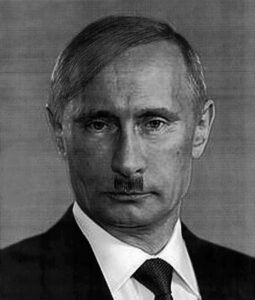 By choosing aggression and war over trade and commerce as primary tools of political influence, Russia is shrinking its own economy and causing its perceived rivals to upgrade their military arsenals — the very thing the Kremlin doesn’t want to see. It has lost its political currency and increased its own economic suffering as the United States, Canada and Europe rally against it with severe sanctions and military readiness.
Russia’s “might is right” totalitarianism is doomed to failure in the long run. Putin’s paranoia and dreams of empire are clearly on the wrong side of history and reality.
Russia may be able to use its brute force to install a puppet government in the Ukraine, as it has elsewhere, but it won’t successfully occupy the country. You can beat people up, but you can’t make them loyal to you with brutality and intimidation. It’s a recipe for continuous resistance and resentment. Russia may win the siege — hopefully not —but it won’t be able to control a large resistant population for long. Eventually, its heavy hand will be broken.
That’s what happened in 1991 when the Soviet Union collapsed because of internal political, economic and ethnic turmoil. Growing unrest and conflict in the SSR’s constituent republics resulted in Russia, the Ukraine and Belarus, the three largest republics, declaring the Soviet Union defunct. Eight more republics quickly followed suite. They couldn’t wait to declare their independence. Estonia, Latvia, Lithuania and Poland joined the European Union and they’ve all been much better off for it.
One has to wonder how Russia would have evolved if the country’s communist party and military elite had embraced General Secretary Mikhail Gorbachev’s plan to gradually reform the Soviet era political and economic system. He promoted policies of glasnost (openness) and perestroika (restructuring) and a path to democracy, but was opposed by old-school hardliners.
Between 1991 and 1999, Russia flirted with change under the erratic leadership of Boris Yeltsin, but since then the country has become a virtual dictatorship as Putin, a former KGB officer and chief of its successor, the FSB, has consolidated his grip on power by murdering political opponents, jailing dissidents, muzzling the media and using military force to install puppets governments in such countries as Belarus, Georgia and Chechnya.
When the Ukraine and Belarus declared their independence in 1991, both countries chose to be non-nuclear nations — and Russia promised to never invade in exchange. Neither was a threat to Russia, but we see now that voluntarily eschewing the nuclear option didn’t guarantee their safety. It only made them targets for Putin’s meglo-maniacal aggression.
No one in Europe or other western democracies has any interest in invading or attacking Russia and that would be true even if it didn’t have 6,400 nuclear missiles. Putin’s assertions otherwise are pure fiction. His policies and politics are governed by paranoia.
His dreams of empire are a throwback to the czars and Stalinist Russian and chillingly reminiscent of Hitler’s vision for a Third Reich (empire) in Germany.
Like Hitler, who was deeply offended by the humiliation of Germany after it lost the First World War, Putin can’t get over the collapse of the Soviet Union in 1991. He wants to put the genie back into the bottle and he’s been hell bent on using military might to do so. He simply doesn’t understand that the Soviet Union passed its expiry date three decades ago and Humpty Dumpty can’t put it back together again. He’s unable to see that Russia can’t occupy and bend multiple countries to its will indefinitely.
Putin’s Russia has turned a number of republics into police states with devastating consequences. Belarus, ruled by a Russian lackey and used as a staging ground for Russia’s invasion of Ukraine, is one of the poorest countries in Europe. Chechnya, a former Islamic republic, is now governed by a Putin ally, Ramzan Kadyrov, a Muslim fundamentalist who routinely uses beatings, torture and death squads to maintain his fearsome grip on power. He’s been cited for numerous human rights violations, including a vicious campaign against gays and lesbians. Russia’s military crushed Chechnya in nine months in 1999-2000. Eight years of insurgency followed in a country of just 1.3 million people. With a population of more than 40 million, the Ukraine has an even greater capacity to resist, beyond guns, bombs and rockets.
As a political boss, Putin is much like Stalin and Hitler. That’s not hyperbole. He’s the all-powerful Fuhrer, the trigger of chaos, death and oppression. His attitude toward Ukrainians as recently expressed in public constitutes a hate crime. “The Ukrainian people do not have a right to exist”, he said, “their language and culture are fictional.”
This kind of genocidal talk demonstrates a repulsive vision that goes well beyond regime change. It’s further evidence that Putin is not fit to be the leader of a big country that aspires to be a modern superpower. He’s still living in the Soviet era, the Cold War past, governing with spent ideas, unable to move forward peacefully. It’s dangerous for Russia and the world for one man, so out of touch with reality and contemporary possibilities, to wield so much power.
Right now, Russia is a country run by a dictator and gangster oligarchs that should be shunned by the world until they get the message that there’s a better way forward.
United Nations delegates were right to vote 141 to 5 against the Russian invasion and walk out on Russian diplomat Sergei Lavrov when he was addressing the General Assembly. The world is tired of Russian lies, propaganda and censorship about its bloody assaults on the Ukraine and other nations.
Russia could be one of the most respected and powerful countries in the world if it were to choose another path and reform itself as a progressive state in its own style. It has the talent, technology, education and resources to do so. Rather than bludgeoning neighbouring countries into submission, it could wield great influence over them with sheer political and economic strength.
As long as it remains a bully boy dictatorship, Europe must remain well armed and refuse to do business with the regime.
Right now, Russia is deservedly reviled for its unprovoked attack on a peaceful country. What will it achieve by destroying the Ukraine’s cities, infrastructure and economy, other than short-term regime change? The spirit of the Ukrainian people won’t be broken. Putin’s invasion is a murderously stupid plan that will ultimately fail.
The free world has no choice but to stand against this killer dictator and his complicit minions in their immoral attack against the brave Ukrainian people, who do exist and have every right to exist as a free and independent nation.
No one should buy any Russian oil, gas, vodka, iron, steel or do any kind of business with Russia until it gets out of the Ukraine and agrees to reparations for the damage it has done with a premeditated, unprovoked war. Vladimir Putin and his bogus geo-politics need to be cast into the dumpster of history where they belong. Russia needs its own regime change to improve its health and welfare — and to make the world a safer place.
On top of all that mentioned in this essay, it is becoming clear that Putin has in fact severely jeopardized Russia’s independence for years to come. Far from rebuilding a Russian hegemony, the once-powerful nation is now falling under the shadow of coercive Chinese soft power. Misguided as people might be about ‘Strong-Man” Putin, the truth is Putin is critically weakened Russia as a world power, doomed now to live in China’s shadow.